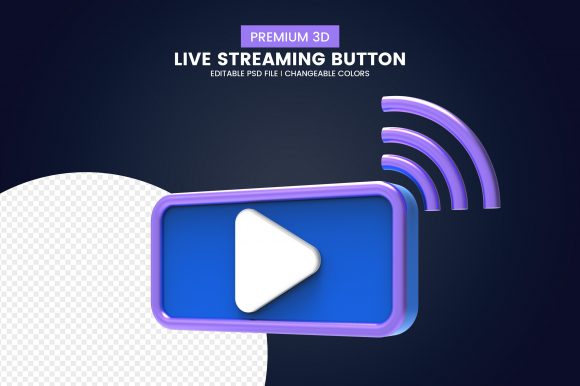
Enhancing Digital Presence with Social Media 3d Live Button Design
In the rapidly evolving landscape of digital design, static elements are no longer sufficient to capture the attention of an engaged audience. As platforms prioritize video content and real-time interaction, the visual tools available to creators must evolve accordingly. One such innovation that has gained significant traction is the Social Media 3d Live Button Design. This specific graphical asset serves as a critical bridge between passive viewers and active participants, transforming simple interface elements into dynamic focal points.
The integration of three-dimensional rendering into user interface (UI) components represents a shift towards more immersive web experiences. When a viewer encounters a button or badge that appears to have depth, shadow, and lighting effects, it triggers a psychological response that encourages interaction. This article explores the mechanics, benefits, and practical applications of these assets, specifically focusing on the versatility of high-resolution renderings suitable for live streaming contexts.
The Psychology of Depth in User Interfaces
To understand why a Live streaming 3d render icon badge isolated design is so effective, one must look at how humans perceive digital space. In a flat, two-dimensional environment, users often struggle to distinguish interactive elements from decorative graphics. By introducing a third dimension through shading, gradients, and perspective, designers create a sense of hierarchy. The eye is naturally drawn to elements that appear to "pop" off the screen.
This principle is particularly vital during live streams. A streamer's screen is often cluttered with chat overlays, game footage, and camera feeds. A standard flat button might get lost in the noise. However, a 3D-rendered badge with realistic lighting and isolation can cut through the visual chaos. It signals importance and action. When a viewer sees a button that looks tactile, they are more likely to click it, join the stream, or share the content. The perceived value of the interaction increases simply because the element looks more substantial and professionally crafted.
Technical Specifications and Versatility
The utility of modern graphic assets lies not just in their aesthetic appeal but in their technical adaptability. High-quality design packages typically include multiple file formats to ensure compatibility across various software ecosystems. For instance, a comprehensive product offering often includes a High-resolution JPG File for quick deployment in marketing materials, presentations, or social media posts where transparency is not required.
However, for professional workflow integration, the inclusion of an Editable PSD File is indispensable. Photoshop documents allow designers to deconstruct the layers of the 3D render. This means that the lighting effects, shadows, and the core icon itself can be manipulated independently. If a brand needs to align the color scheme of a live button with their corporate identity, the ability to adjust hue, saturation, and brightness without losing quality is crucial. Furthermore, the transparent background feature ensures that the badge can be placed over any video feed, website background, or image without unsightly white boxes or clipping issues.
The capacity to modify size and color makes this type of asset suitable for a variety of projects. Whether the requirement is a massive banner for a conference presentation or a tiny icon for a mobile application notification, the vector-based principles often underlying these PSD files allow for scaling without pixelation. This flexibility supports a wide range of professionals, from hobbyists creating custom Twitch overlays to business owners managing corporate webinar interfaces.
Applications Across Different Industries
The reach of the Social Media 3d Live Button Design extends far beyond simple gaming streams. Its application is broad, serving diverse sectors that rely on visual communication and real-time engagement.
- Content Creators and Streamers: For influencers on platforms like YouTube, Twitch, and TikTok, retention is key. An animated or static 3D badge indicating "LIVE NOW" creates urgency. It draws the eye immediately to the active status of a channel, potentially increasing click-through rates from browse pages.
- Educators and Researchers: As remote learning and virtual conferences become standard, educators need clear indicators for when a session is active. A professionally designed 3D badge can be used in email newsletters or LMS dashboards to signal that a lecture is currently broadcasting.
- Business Owners and Marketers: Companies hosting product launches or Q&A sessions require clear calls to action. Integrating a 3D render into landing pages can highlight the "Join Webinar" button, separating it from other navigation links and guiding the user toward conversion.
- Hobbyists and Community Managers: Even small community groups benefit from professional aesthetics. A well-designed badge adds a layer of polish to Discord servers or private forums, making the community feel established and trustworthy.
Implementation Strategies for Maximum Impact
Simply adding a graphic to a page does not guarantee success; strategic implementation is required. When utilizing a Live streaming 3d render icon badge isolated design, consider the context of the surrounding content. The lighting direction of the 3D object should match the lighting in the scene. If a streamer's setup has a blue rim light on the left, placing a 3D badge with a warm light source on the right may create a disjointed visual experience. Most editable PSD files allow for the adjustment of overlay colors and blend modes to harmonize the badge with the environment.
Another consideration is the balance between animation and stillness. While some trends favor motion, there is a time for static clarity. A high-resolution JPG version of the button is perfect for thumbnails where motion cannot be previewed. Conversely, using the PSD file to extract the layers allows for subtle CSS animations on websites, such as a slight hover effect that lifts the button or changes its glow intensity. This interactivity reinforces the 3D illusion and rewards the user for engaging with the interface.
For those working within limited bandwidth constraints, the choice of file format matters. The Zip File distribution method mentioned in many professional asset packs is efficient for delivery, ensuring that all necessary components—high-res images, source files, and documentation—are bundled together. This prevents the common issue of missing linked textures or broken layers when moving files between different computers.
Design Trends and Future Outlook
The trend towards 3D UI elements is part of a larger movement in web design known as "Spatial Web" or "Web 3.0" aesthetics. As browsers become more powerful and capable of rendering complex graphics natively, the line between web design and 3D modeling continues to blur. The Social Media 3d Live Button Design is a precursor to fully interactive 3D environments where buttons might react to mouse movements with parallax effects.
Currently, the most effective approach remains the use of high-fidelity renders that simulate physical materials. Glassmorphism, metallic finishes, and soft plastic textures are popular styles that convey modernity and tech-savviness. These designs suggest that the platform or service behind the button is cutting-edge. As audiences become desensitized to flat design, the novelty and depth of 3D elements provide a fresh visual hook that keeps users interested.
Furthermore, the demand for customization drives the market. Users no longer want generic stock photos; they want assets that fit their specific brand voice. The ability to edit the color and size of the badge directly in the source file empowers users to maintain brand consistency while leveraging high-end design techniques. This democratization of professional-grade graphics allows smaller creators to compete visually with larger networks.
Key Considerations for Selection and Usage
When selecting a design asset, it is essential to verify the resolution and layer structure. A low-resolution image will look blurry when scaled up, ruining the 3D illusion. Always ensure the package includes a High-resolution JPG File suitable for print or large displays. Additionally, check if the PSD file is organized with named layers. A chaotic file structure can make editing frustrating and time-consuming.
Transparency is another non-negotiable feature. The isolated design with transparent background ensures that the badge can be overlaid on any content without manual masking. This saves hours of work in post-production. If a designer has to manually remove a white background from every single frame of a video, it is inefficient. Pre-made isolated assets streamline the workflow significantly.
Finally, consider the emotional resonance of the design. Does the button look inviting? Does the 3D rendering feel heavy and serious, or light and playful? The style should match the tone of the project. A financial institution hosting a live investor call might prefer a sleek, metallic, silver-toned 3D button, whereas a gaming tournament would benefit from a vibrant, neon-lit badge. The versatility of the editable PSD File allows for this nuance to be achieved regardless of the initial preset.
Conclusion on Visual Engagement
The evolution of digital communication relies heavily on the ability to grab and hold attention. In a crowded information ecosystem, the difference between a viewed link and a clicked action often comes down to visual prominence. The Social Media 3d Live Button Design offers a sophisticated solution to this challenge, combining artistic depth with functional utility.
By providing a tool that is both aesthetically striking and technically flexible, these assets empower creators to elevate their production value. Whether through the crisp detail of a high-resolution JPEG or the granular control of an editable PSD, the potential for customization ensures that the final result fits perfectly within any project scope. As we move forward into an era of increasingly immersive digital interactions, the adoption of 3D elements in UI design will likely transition from a trend to a standard practice. For professionals, educators, and hobbyists alike, investing in high-quality, versatile design resources is a strategic step toward enhancing user engagement and achieving clearer communication goals.
Thank you for visiting my store. Feedback is always welcome as we continue to refine these tools to meet the changing needs of the creative community.